
Sketching Sacrament
Originally written in 2017 and revisited in 2025.
There are moments in an artist’s practice when the work becomes less about skill and more about noticing. This sketch marks one of those moments for me—a point when research, curiosity, and the act of drawing began to shift the way I approached form and meaning.
In 2017, I wanted to loosen my grip on being entirely self-directed and allow something outside myself to guide the process. I was looking for a symbol that carried weight—something with structure, history, and enough complexity to challenge the way I usually began a piece. That search led me to religious iconography and, specifically, the Eastern Orthodox cross, also known as the Suppedaneum Cross.
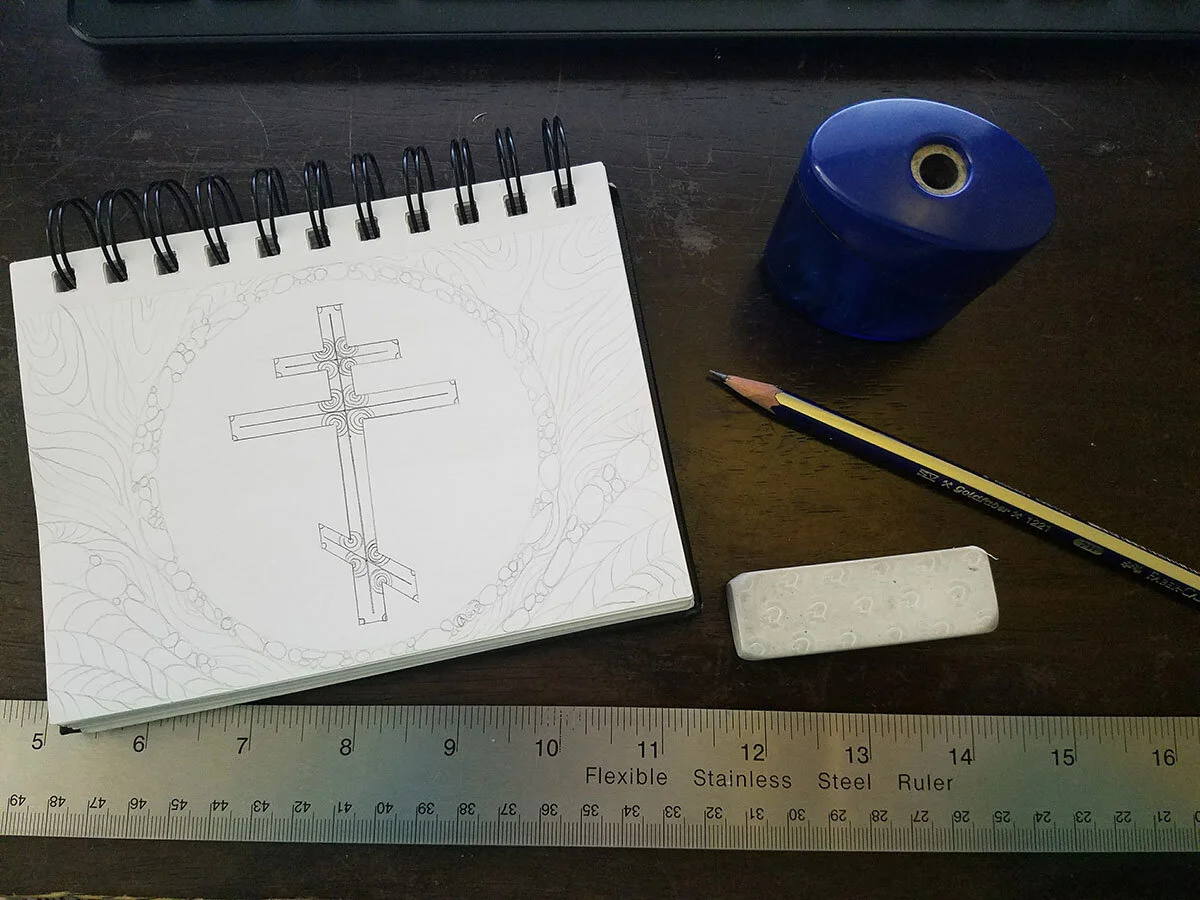
I was familiar with the Christian cross, but I didn't understand the nuances of its variations. So I read and researched. The more I learned, the more the drawing took shape. The three bars of the Orthodox cross became the anchor for the composition: the upper bar for the inscription, the central bar for the body, and the angled lower bar referencing the footrest.
I started with a simple outline. Then it asked for structure.
A central line.
A clearer axis.
Points of connection marked and emphasized.
Once the form was established, I instinctively began adding references to the environment surrounding the original event—rock, dirt, wind, and topographical contours. Looking at the sketch now, I can recognize something I couldn't have articulated as clearly then: I was already thinking in layers of symbol, context, and place.
That is what makes this small drawing interesting to me years later.
The exercise wasn't ultimately about creating religious imagery. It was about discovering what could happen when I allowed external research to interact with intuition. I had to consider the history and established meaning of a symbol while still finding my own visual response to its form and structure.
At the time, I didn't know whether I would take the sketch further—enlarge it, ink it, or develop it into a series. I didn't need to know. The drawing had already done something more important: it had changed the way I approached the beginning of a work.
Revisiting it now, I can see an early trace of questions that continue to surface throughout my practice: how structure carries meaning, how place enters an image, and how something encountered outside myself can be transformed through observation and making.
Sometimes the smallest sketches leave the longest echoes.
